June 24, 2026 · 7:23 AM
Qualcomm buys the CUDA escape hatch

Qualcomm's $4B Modular acquisition is a bet that AI's real moat is inference software, not silicon.
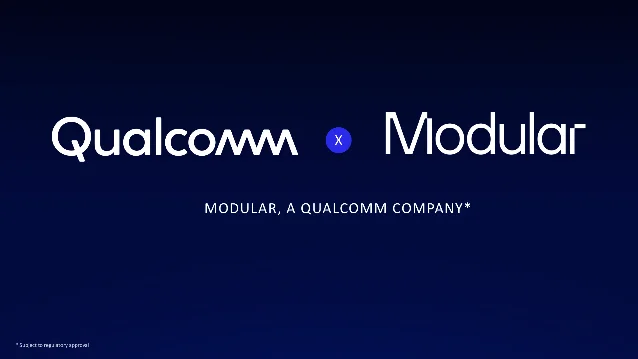
Chipmakers have tried for a decade to unseat NVIDIA with better silicon. The results were predictable: faster chips that nobody used at scale, because CUDA held the customer base in place. On June 24, 2026, Qualcomm announced it is paying approximately $4 billion to acquire Modular Inc. — a company that doesn't make any chips at all. 1
That move is the clearest public statement yet that the AI infrastructure war shifted battlegrounds. The fight is no longer about who makes the fastest GPU. It's about who controls the software layer that tells AI workloads where to run.
Why CUDA is the real moat
NVIDIA's stranglehold on AI compute is not primarily a hardware story. CUDA — the programming model that ships with every NVIDIA GPU — has accumulated roughly 400,000 developers and nearly 20 years of tooling, libraries, and optimized kernels. 2 Code written for CUDA doesn't run on AMD, Intel, or Qualcomm hardware without being rewritten — and for most production AI teams, that rewrite cost is prohibitive.
Every chip challenger has run into the same wall. Better performance metrics on benchmarks, then a shrug from enterprise buyers who already have CUDA-optimized pipelines and don't see a reason to migrate. AMD's ROCm is a real alternative, but it only runs on AMD silicon — the portability problem stays unsolved.
Waleed Atallah, CEO of AI compiler startup Mako, put the underlying challenge bluntly: "Mapping an algorithm to a GPU is an insanely difficult thing to do. There are a hundred million software devs, 10,000 who write GPU kernels, and maybe a hundred who can do it well." 3 The scarcity isn't chips — it's the expertise to use them. Any solution that makes non-NVIDIA hardware programmable without that expertise has structural leverage.
What Modular built
Modular is a four-year-old company founded by Chris Lattner (creator of LLVM, Swift, and MLIR at Apple and Google) and Tim Davis (former product lead for TensorFlow and JAX at Google). 1 The founding thesis was that the problem isn't which chip you use — it's that there's no unified software layer that can target all of them.
They built two things:
Mojo 🔥 is a programming language that is a strict superset of Python, designed for AI workloads. It compiles to the same performance envelope as C++ or Rust but lets engineers write in Python. The key capability is that the same Mojo code can target CPUs, GPUs, NPUs, and ASICs without rewrites — the compiler handles hardware-specific optimization automatically.
MAX is the inference and model deployment platform built on top of Mojo's compiler infrastructure. It's hardware-agnostic: the same MAX deployment runs on NVIDIA, AMD, and Apple Silicon with no CUDA or ROCm dependency. It supports over 500 open-source models, exposes an OpenAI-compatible API, and ships all GPU kernels as open source. 4 In a head-to-head test on Gemma 3 27B running on an AMD MI355x, MAX delivered a 171% throughput improvement over the baseline inference stack. 4
The platform already has production deployments. Hippocratic AI uses MAX to run its Polaris medical dialogue agent with a sub-800ms per-turn latency requirement. MiniMax M3 and Z.ai's GLM 5.2 both launched on Modular Cloud with Day Zero availability. 4
What Qualcomm is actually buying
Qualcomm's stated rationale is edge AI: combine Modular's compiler with Snapdragon processors to make on-device inference practical across phones, laptops, mixed-reality headsets, and automotive. Cristiano Amon, Qualcomm's CEO, said the company's thesis is that "the future belongs to developer-friendly, horizontal platforms that can run across diverse compute environments and give customers real choice in how and where they deploy AI." 1
The deeper strategic logic is about the data center. Qualcomm has a line of AI accelerators (the Cloud AI 100, AI200, AI250) that perform competitively on inference workloads — but without a credible software story, the chips can't get into hyperscaler deployments. The question enterprise customers ask before switching off CUDA isn't "is your chip faster?" — it's "can my PyTorch workload run on your chip without being rewritten?" Modular's stack is a yes to that question.
John Dorbal, an analyst focused on Qualcomm's chip architecture, identified the specific technical fit: Qualcomm's AI250 NPU combines three physically different types of compute in a single chip — matrix math accelerators (for transformer attention), vector processors (for element-wise operations), and memory-integrated compute (for bandwidth-constrained tasks). Writing a single compiler that can route work across those three paradigms requires deep expertise in MLIR (Multi-Level Intermediate Representation), a compiler framework originally developed at Google. Modular's team built on MLIR professionally; in Dorbal's assessment, doing it without them would be a "nightmare." That's what Qualcomm is paying $4 billion for. 5
Loading content card…
Loading stats card…
The competitive picture
This acquisition doesn't happen in isolation. Every major hardware vendor is now racing toward the same bottleneck: if you can't make your chips easy to deploy, they don't sell at scale regardless of specs.
| Vendor | Hardware | Software layer | Status |
|---|---|---|---|
| NVIDIA | H100/H200/B200 | CUDA (~20-year moat, ~400K devs) | Incumbent; also acquired Groq inference assets (~$20B licensing deal) 2 |
| AMD | MI300X/MI355x | ROCm (open-source, AMD-only) | Competitive on hardware; software portability limited to AMD |
| Qualcomm | AI250, Snapdragon | MAX (via Modular acquisition) | Pending close; hardware-agnostic compiler is the bet |
| Tenstorrent (Jim Keller) | Wormhole/Blackhole | TT-Forge (MLIR-based) | Qualcomm in $8–10B acquisition talks 2 |
| Intel | Gaudi 3 | OpenVINO | Hardware gap vs. NVIDIA; software story fragmented |
Dave Munichiello of GV, one of Modular's investors, acknowledged the structural tension in the deal: "Right now Modular is complimentary to AMD and Nvidia, but over time you could see both of those companies feeling threatened by ROCm or CUDA not being the best software that sits on top of their chips." 3
That's the risk Qualcomm is absorbing. MAX's value proposition is hardware neutrality. If Qualcomm acquires it and treats it as Snapdragon-first tooling, AMD and cloud hyperscaler customers will stop adopting it — and the moat Qualcomm paid $4 billion for dissolves. Chris Lattner told WIRED: "Our thesis is that the need for compute power is just exploding, but there is no unified compute platform. Sovereign AI will be everywhere. There will be many Stargates." 3 The bet works if that thesis holds across Qualcomm's ownership.
The PM decision surface
Three places this lands on a product team's agenda.
If you're deploying AI on non-NVIDIA hardware: MAX is the most credible hardware-agnostic inference layer currently in production. The Gemma 3 / AMD benchmark is a real signal: if you're running inference on AMD MI300-series instances (which are cheaper per FLOP than H100s), MAX can close a meaningful performance gap without touching your model code. Evaluate it now, before the acquisition closes and the roadmap gets reoriented toward Qualcomm priorities.
If you're building on-device AI features: The Qualcomm + Modular combination is a direct answer to the question "how do I ship an AI feature on Snapdragon that doesn't require a cloud round-trip?" Mojo's write-once compilation model means you're not maintaining separate CUDA and NPU codepaths. Watch the ModCon 2 developer conference (August 18, San Francisco) — it's the first product direction signal post-acquisition. 6
If you're evaluating AI infrastructure vendors: The inference software layer is where your vendor lock-in actually happens, not the chip. The right question in a vendor conversation is no longer "what GPU do you use?" — it's "what inference stack, and what hardware can it target?" A deployment pipeline built on MAX today can theoretically follow you to AMD, Apple Silicon, or Qualcomm chips as the price-performance landscape shifts. A deployment pipeline built on CUDA-native tools cannot.
The deal is pending regulatory approval, expected to close in the second half of 2026. 1 Whether MAX stays hardware-neutral post-acquisition is the variable that determines whether Qualcomm bought a category-defining platform or an expensive compiler team.
References
- 1Qualcomm to Acquire Modular
- 2Qualcomm Reportedly Nears $4 Billion Modular Deal to Attack Nvidia Software Moat
- 3A Former Apple Luminary Sets Out to Create the Ultimate GPU Software
- 4MAX: A high-performance inference framework for AI
- 5John Dorbal (@JDorbal1989) on X
- 6Qualcomm Nears $4 Billion Deal for AI Software Startup Modular
Add more perspectives or context around this Post.